Better Eye Blinks
Until recently, the eye blink system was fairly basic. It involved two animation cycles, one for eyelids closing and one for eyelids opening. The first cycle was timed to be slightly shorter than the first and they both used basic ease in/out curves.
But ultimately the results were as basic as the above description.
Eye blinking is actually reasonably complex and fairly variable in nature. I came across some research that helped influence the newer eye blink system.
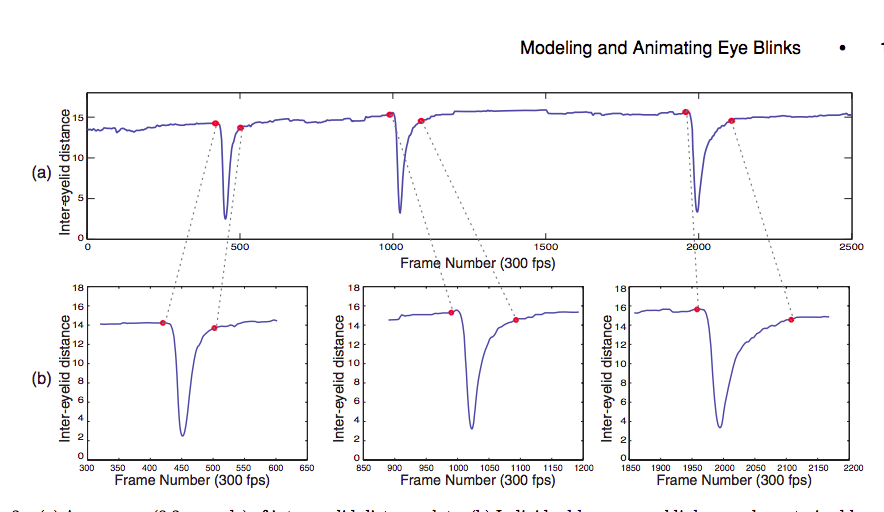
Fig. 2. Images of the eye at: (a) the beginning of the eye blink, (b) the maximum closed position, and (c) the end of the blink. (d) Overlaid images of the eye during blinking. The blurring of the markers on the lower eyelid demonstrates the displacement of the lower eyelid during the eye blink.
One curve
The new system uses a single curve to determine the lid position during the full blink cycle. This allows for post blink falloff, the correction of the upper lid post-blink. Additionally, there is a new control for the amount of blink speed variance as well as left/right alternating speed variance.
One of the nice things about this approach is that with sufficient tracking data of the eyes for a given subject, we can precompose the eye blink curve (or a set of common curves) using training data. This will enable us to capture the likeness of the source human.